For my students · Strategic Thinking in Design

From Personas to Populations

What happens to your design toolkit when you're designing for 1.4 billion people?

Speaker
Sridhar
Role
Principal Design Advisor, UIDAI
Focus
Aadhaar & Digital Public Infrastructure
01

The Billion-User Question

In design school, we learn about personas, user journeys, and affinity mapping. These tools work beautifully when you're designing an app for urban millennials or a website for enterprise customers.

But what happens when your "user" is 1.4 billion people across 22 official languages, spanning literacy levels from PhD scholars to those who sign with a thumbprint?
1.4B
Aadhaar enrollments
22
Official languages
6
Literacy categories
1M+
Possible user journeys

What if we fit Persona to a combinatorial?

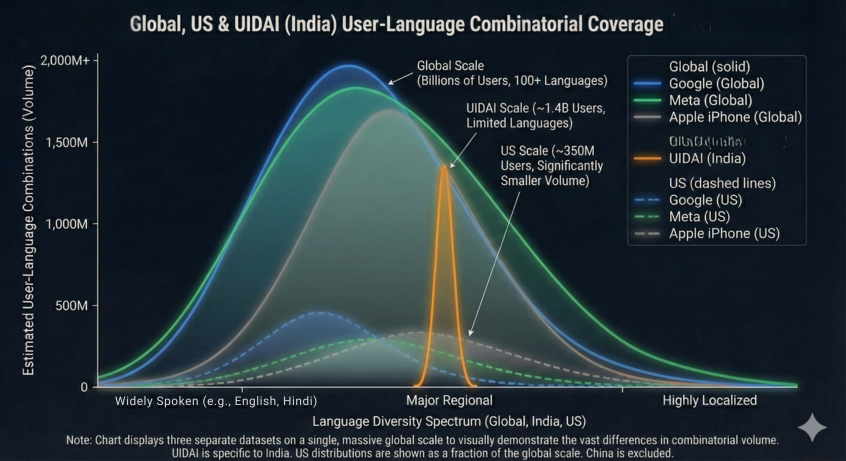
At population scale, does design default to personas around the average distribution? Persona as a combinatorial of number of users or population size, combined with factors that restrict access ie. language, network, devices among others, then how does one cluster for unique archtypes to map population scale behaviours?


Compare user distribution for populations using a bell curve or a normal distribution in the chart below. India's Aadhaar digital identity and credentials program is one of the worlds largest. But at a combinatorial of population size x number of spoken languages, then, the scale at which Google, Meta, etc operate dwarfs. This chart shows how from a global scale at over 100+ languages, to India's Aadhaar at 22+ languages and US at lesser scale, the emerging evidence of usage across the three scales of mix and diversity shows that most users cluster the middle where english is the language of interaction in the user interfaces. The hypothesis according to author of this post is due to the presence of two modes of user interaction - assistive and self service. Assistive can be either formal via support agents or informal via friends, family, community. Self service is largely by using online sources like Youtube, Instagram posts, reels that influencers advise with how to guides. Search and discovery are key mechanisms that lead to consuming the content, learning, acting.

Below, we investigate how to design for diversity, scale and impact via

Discovery > Appeal > Interaction > Delight


The primary emphasis is borrowed from human factors approach adopted by indsutrial designers, where you design for the extremes ie +/- 2.5% of total users.

How do you make personas for a billion people?

— The question that started this conversation

02

When Textbook Methods Work

Let's be clear: personas, affinity mapping, and user shadowing are powerful tools. They emerged from product design contexts where they solve real problems brilliantly.

The Design Envelope

Textbook methods work when you have: bounded user groups, defined use cases, controllable environments, and iterative deployment capabilities. A banking app for young professionals? Perfect for personas. An e-commerce checkout flow? Affinity mapping shines.

Real-World Example

When Spotify designs their "Discover Weekly" playlist experience, personas work beautifully. They can identify distinct listener types: the "Mood Curator" who creates playlists for specific activities, the "Genre Purist" who deep-dives into specific styles, the "Eclectic Explorer" who enjoys variety. Each persona informs different feature priorities and UI decisions. The user base, while large, shares fundamental contexts: smartphone access, subscription model understanding, and music consumption patterns.

03

The Limits of Personas at Population Scale

At Aadhaar, we cannot create personas for a billion people. The diversity isn't segmentable into 5-7 archetypes. The traditional persona approach assumes you can find meaningful clusters—but when your users range from tech-savvy urban professionals to elderly villagers who've never touched a screen, the clusters become meaningless.

Traditional Persona Thinking
  • Segment users into 5-7 archetypes
  • Design for the "average" within each segment
  • Optimize for majority use cases
  • Iterate based on segment feedback
  • Assume shared technological context
Population Scale Thinking
  • Design for extreme edge cases
  • If it works for the most constrained, it works for all
  • Build in graceful degradation
  • Assume nothing about technological literacy
  • Design for assisted and direct interaction modes

The Method of Extremes

Instead of designing for the average, we design for the extremes. If an enrollment process works for a 90-year-old woman in a remote village with arthritic hands and fading eyesight, it will work for a 25-year-old software engineer in Bangalore. The reverse is never true.

Case Study: Biometric Capture

Early Aadhaar enrollment centers discovered that manual laborers often had worn fingerprints that failed standard scanners. Rather than creating a "laborer persona" and designing a separate flow, we redesigned the entire capture process to handle degraded biometrics gracefully—using iris scans as backup, allowing multiple capture attempts, and training operators for edge cases. This universal design now serves everyone better.

The question isn't 'who is our user?' but 'what are the most challenging conditions under which our system must still work?'

— Design principle for Digital Public Infrastructure

04

From User Research to Systems Thinking

When your "user" is an entire population, research shifts from ethnographic depth to understanding systemic constraints. We still care about people, but we analyze at a different altitude.

Infrastructure Reliability

What happens when network connectivity drops mid-transaction? How do we handle power outages at enrollment centers? Design must account for systems failing gracefully.

Institutional Capacity

Can bank clerks in rural areas be trained to operate the system? What's the cognitive load on government employees processing thousands of requests daily?

Policy Requirements

Regulatory compliance isn't a constraint to work around—it's a design requirement. Privacy laws, data protection, audit trails: these shape the solution space.

Failure Mode Analysis

At scale, even a 0.1% failure rate means millions of failed interactions. We design for recovery, not just success.

Systems Thinking in Practice

Consider the UPI (Unified Payments Interface) system. Traditional UX would focus on the payment screen design. Systems thinking asks: What happens when a transaction times out? How do we handle the case where money is debited but not credited? How do we design for dispute resolution at scale? The actual payment UI is perhaps 10% of the design challenge—the system architecture is the other 90%.

05

Digital Public Infrastructure: A Different Design Problem

DPI isn't a product; it's plumbing. Aadhaar, UPI, and similar systems are designed for ecosystem enablement, not feature completeness. Strategy here means designing for what others will build on top.

The Platform Mindset

When you build a road, you don't design for specific cars—you create a surface that any vehicle can use. DPI works the same way. Aadhaar doesn't compete with specific identity solutions; it provides an identity layer that thousands of services build upon.

We don't design features. We design capabilities. The feature is what someone else builds using our capability.

— DPI design philosophy

Ecosystem Effects

Consider what happened after Aadhaar launched: DigiLocker emerged for document storage, eSign for digital signatures, eKYC transformed banking onboarding. None of these were designed by the Aadhaar team—but all were enabled by the identity infrastructure. Good DPI design anticipates and enables this ecosystem growth.

06

Designing for "Billion Users, Million Journeys"

The emerging challenge: how do we enable contextually appropriate experiences while maintaining compliance and trust? This requires separating the deterministic from the adaptive.

Canonical (Fixed)
  • Regulatory requirements
  • Legal compliance steps
  • Audit trail requirements
  • Security protocols
  • Data validation rules
Adaptive (Flexible)
  • Interface language and tone
  • Step sequencing for context
  • Help and guidance systems
  • Error recovery flows
  • Interaction modalities

The Separation Principle

The canonical layer is non-negotiable—the same data must be collected, the same validations must pass, the same audit trails must exist. But how a user gets there can be infinitely adaptive to their context, capability, and needs.

07

Strategic Thinking = Choosing Your Methods

Design strategy isn't about applying techniques; it's about understanding the problem's structure and selecting—or creating—methods that fit. Sometimes you need personas. Sometimes you need policy analysis. Often you need both.

The Strategic Designer's Mindset

Before reaching for any tool, ask: What's the scale? Who are the stakeholders? What are the constraints? What must remain fixed versus what can adapt? Only then choose—or invent—your methodology.

Method-First Thinking
  • "We should do user interviews"
  • "Let's create personas"
  • "We need affinity mapping"
  • Techniques seeking problems
Problem-First Thinking
  • "What's the actual constraint here?"
  • "What would failure look like?"
  • "Who else has solved this?"
  • Problems seeking appropriate methods

The most strategic design decision is often which methodology not to use.

— Learning from population-scale projects

08

What Industry Actually Needs from Designers

The ability to zoom out (systems, constraints, stakeholders) and zoom in (interaction, friction, delight). Not allegiance to methods, but judgment about when each method serves the problem.

→

Systems Awareness

Understanding that your design exists within larger technical, organizational, and social systems that shape what's possible.

→

Constraint Navigation

Working creatively within limitations—technical, regulatory, resource-based—rather than fighting them.

→

Scale Sensitivity

Knowing that methods appropriate for 1,000 users may fail at 1,000,000 users—and designing accordingly.

→

Methodological Flexibility

Having many tools in your toolkit and the wisdom to choose the right one—or invent a new one when needed.

09

Questions for Your Own Practice

As you approach your next design challenge, consider these framing questions:

?

Boundary Awareness

What are the actual boundaries of your design problem? Where does your system end and another begin?

?

Inclusion Analysis

Who benefits from your design? Who might be excluded? Is that exclusion intentional and justified?

?

Method Fit

What methods does this specific context demand? Are you using techniques because they fit, or because they're familiar?

Interactive Assessment

Test Your Understanding

Question 1 of 5

When designing at population scale (like Aadhaar), why doesn't the traditional persona approach work well?

Question 2 of 5

What is the "Method of Extremes" in population-scale design?

Question 3 of 5

In Digital Public Infrastructure (DPI) design, what's the key distinction between "canonical" and "adaptive" layers?

Question 4 of 5

How does systems thinking differ from traditional user research in population-scale design?

Question 5 of 5

What does "problem-first thinking" mean for strategic designers?

0/5